
High-capacity contact centre
A mission-critical contact centre built as part of a crisis-management deployment, sized for peak load with no tolerance for dropped calls.

Software-defined IP PBX, IVR and contact-centre infrastructure — running on the same hardened network we built for you, integrated with the systems your team already uses.
The problem
Legacy analog lines are billed per line, per month, forever, and every change request means an engineer visit. Calls are not logged anywhere useful, nobody can tell you how long the average customer waited, and the phone system has no idea who is calling even though your CRM does. It is one of the largest recurring costs in a business that nobody re-examines.
What we do about it
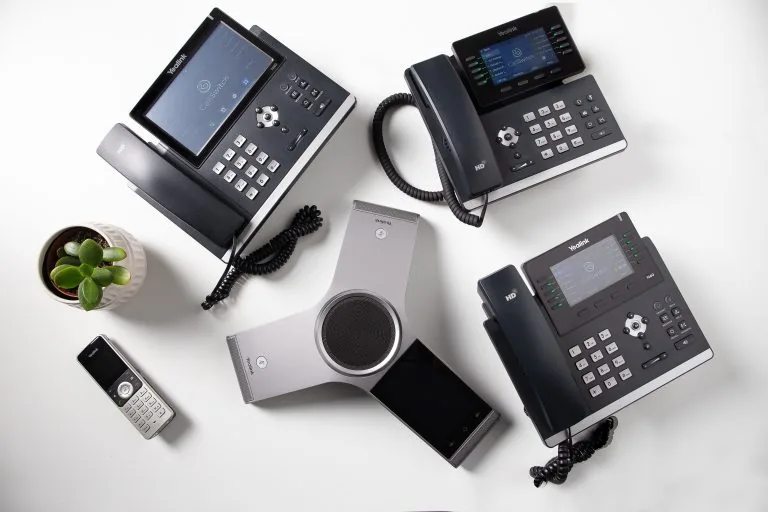
We move voice onto software-defined IP telephony hosted on your own infrastructure. Extensions, call groups, IVR menus and call recording become configuration rather than hardware. Because it runs on the network we hardened — on its own isolated VLAN — call quality is protected from whatever else the office is doing, and the platform can talk to your CRM, your ticketing system and your automation layer.
How we work
What you get
Per-line rental disappears. Adding an extension becomes a configuration change instead of a site visit and an invoice.
Volume, wait time, abandonment and outcome per agent are visible — usually for the first time in the company’s history.
Integrated with your CRM, the system can route a known customer to the person who handled them last, with their record already open.
Equipment & stack



In the field
A mission-critical contact centre built as part of a crisis-management deployment, sized for peak load with no tolerance for dropped calls.

Branches on one dial plan, calling internally at no cost, with out-of-hours calls following a documented escalation path instead of ringing out.
Questions we get asked
Voice quality is a network property. This service assumes the segmentation and QoS work described under Networking.
Next step
Send the constraint you are actually stuck on — a floor plan, a network that keeps dropping, a process nobody wants to do by hand. An engineer reads it and replies.