Back to services

A network that stays up when the ISP does not.

High-availability fabric, zero-trust segmentation and dual-WAN failover — engineered to your building and your load, not to whatever box was in stock.

The problem

Most offices and large homes put up with a patchy signal, dead spots and dropouts. The cause is nearly always the same. Off-the-shelf gear, fitted with no survey of the traffic it has to carry. No plan for the building. No security baseline. It works on demo day and buckles under real use — and by then the fault is inside the walls.

What we do about it

We build hardened, high-availability networks, sized to your real floor area and your real load. That means isolated VLANs, and failover between two carriers that switches itself. It means edge security fitted on day one, not bolted on after a breach. The result keeps its speed under load, and it can grow without being torn out.

How we work

From first site visit to handover.

01 Site audit and RF survey We map the building and measure how the signal really behaves, rather than guessing from a floor plan.
02 Infrastructure simulation Routing, hardware limits and traffic flows are worked out before anything is ordered.
03 Deployment and hardening Racks are mounted and wired, routing set up, and every factory default replaced.
04 Zero-trust segmentation Isolated VLANs split work traffic, guest access, phones and IoT kit, so no class of device can reach another.
05 Continuous optimisation Remote dashboards show us what is happening live, so we can step in before a fault becomes an outage.

What you get

No single point of failure

If one line dies, the second takes over on its own. Nobody in the building notices the switch.

Segmentation that actually holds

Your business data is walled off from guest devices and IoT kit by the network itself, not by a written rule.

Latency that stays low

Bandwidth is shared on purpose, so 4K cameras and phone calls hold up when the office fills.

Equipment & stack

Routing and switching
Ubiquiti Omada and Cisco managed switches and security gateways
Virtualisation
Proxmox VE hosting self-managed local infrastructure services
Monitoring
Containerised monitoring agents feeding predictive telemetry
  • Cisco
  • TP-Link
  • Fortinet
  • NETGEAR
  • D-Link
  • Zabbix
  • LibreNMS

In the field

Mission-critical control infrastructure

The network backbone for a crisis-management centre that is not allowed to drop a single packet.
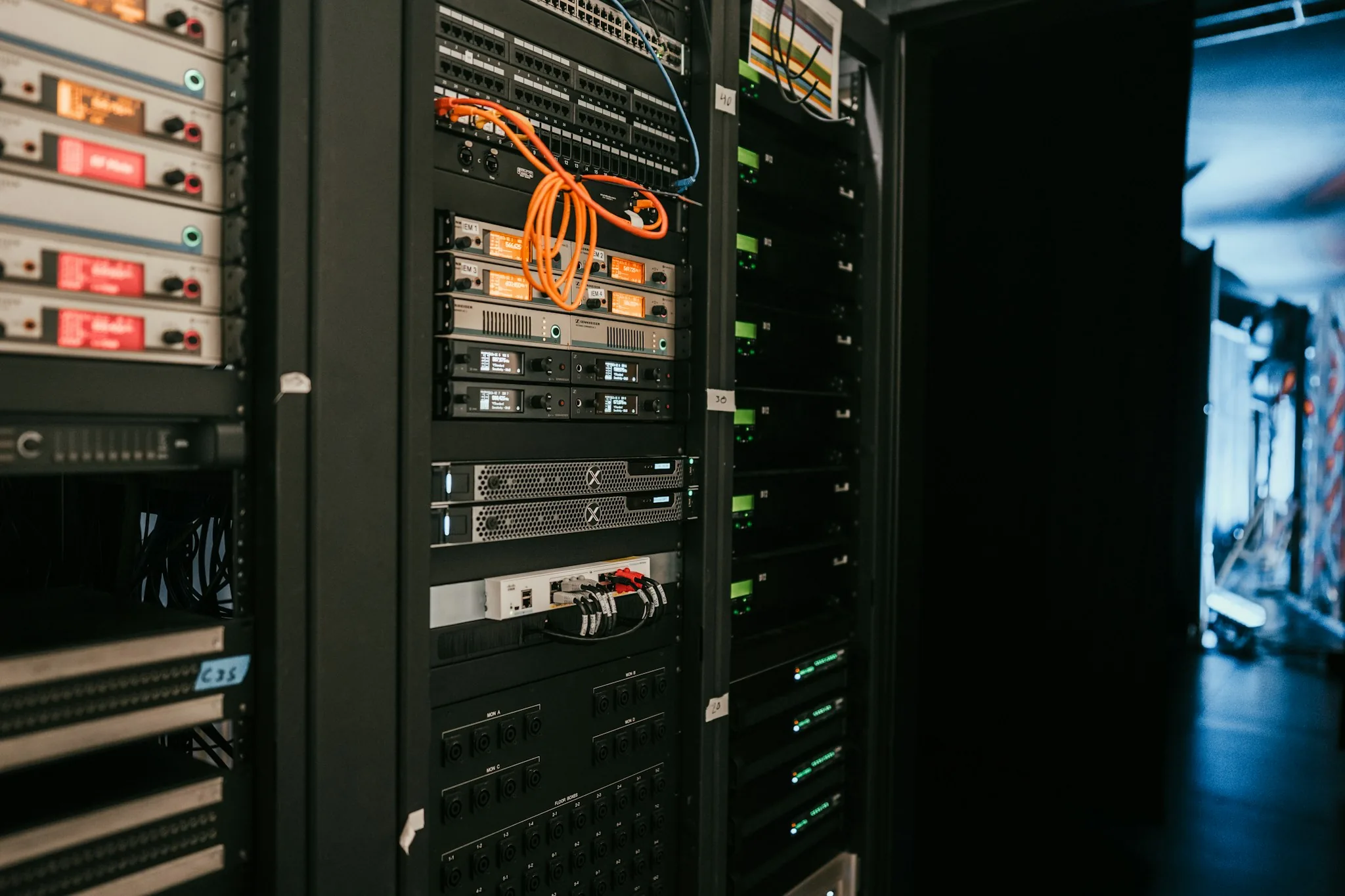
Multi-VLAN corporate workspace

Voice, data and IoT sharing one office network, with no measurable drop in speed.

Questions we get asked

Will re-architecting our network mean downtime?
No. Migration runs in parallel phases and the cut-over happens off-peak. Daily operations are not interrupted — that constraint is designed into the plan from the start.
Why not just use the router our ISP provided?
ISP routers are consumer boxes. They lack the memory to hold high concurrent connection counts, they cannot do the VLAN segregation that keeps IoT away from your business data, and their exposed services are a standing perimeter risk.
Can this grow with us?
That is the point of doing the capacity work up front. The fabric is sized for the load you will have, not the load you have today, so growth means adding hardware — not replacing the design.

Everything else we build sits on this. Telephony, cameras and IoT all assume a segmented, reliable fabric underneath them.

Next step

Tell us the problem, not the product.

Send the constraint you are actually stuck on — a floor plan, a network that keeps dropping, a process nobody wants to do by hand. An engineer reads it and replies.

Chat with us on WhatsApp